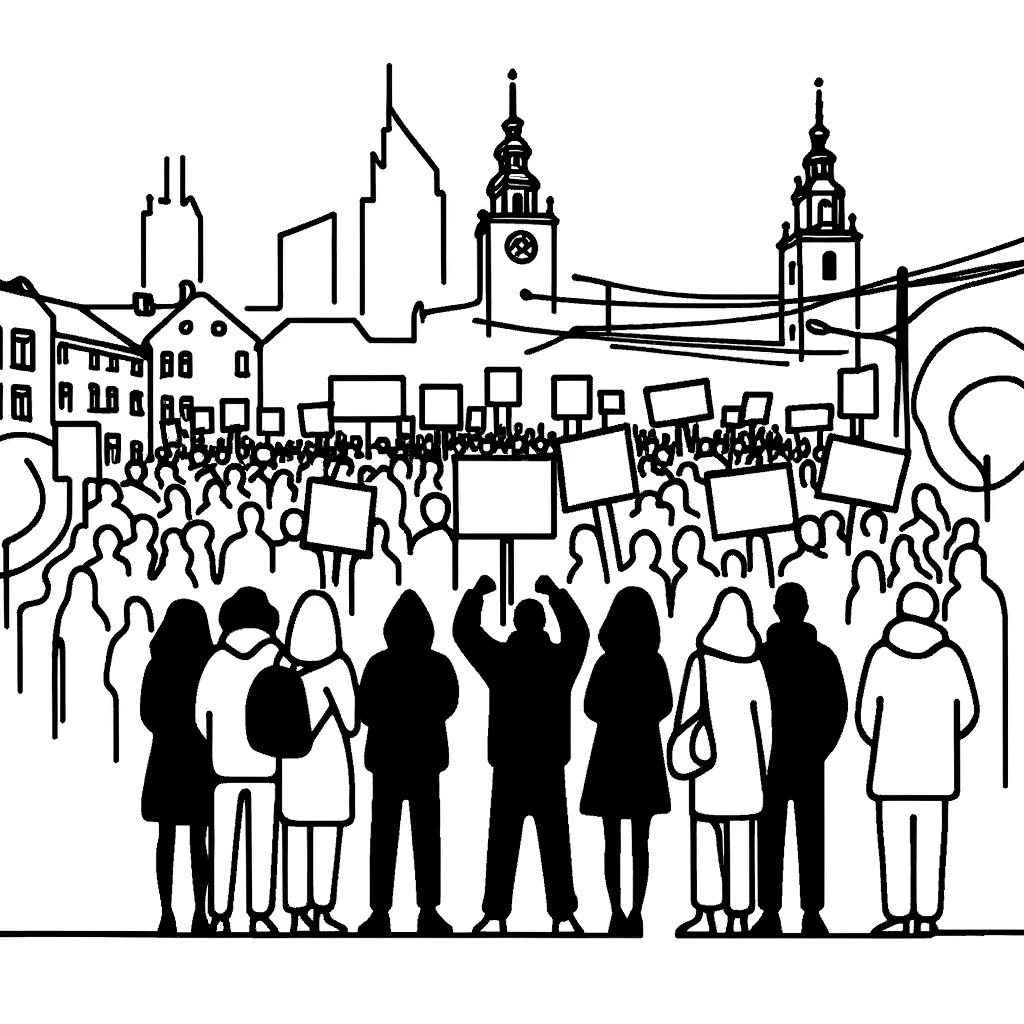
We, the research team funded by the National Science Centre (NCN), Poland (2021/43/B/HS6/01155) grant entitled “The Construction of Post-Pandemic Society: Covid-19 Street Protest in Poland,” presented three papers in 2023. One of them was “Reconstructions of the Covid-19 Protests in Poland: Using Text, Pictures, and Video Data to Derive Visions of Social Change” at WZB Berlin.
Here are two more:
Is contestatory constitutionalism possible in Poland? Notes from the climate socio-legal mobilization in the Covid-19 era
Alan Żukowski, University of Wrocław & Institute of Philosophy and Sociology, Polish Academy of Sciences, and Martyna Stępień, University of Wrocław & Jagiellonian University
This paper explores the viability of contestatory constitutionalism in Poland, focusing on the socio-legal mobilization of Fridays for Future against the Covid-19 pandemic policies enacted by the ruling populists. Contestatory constitutionalism views traditional state-based constitutionalism as a tool reinforcing neo-liberal control, impeding emancipation. Therefore, the core societal goal is to employ legal means to challenge prevailing power dynamics, favoring public involvement over judicial supremacy or majoritarian rules, and anchoring constitutional assertions in the realm of contentious politics.
The research explores two facets of constitutionalism’s role in Poland during Covid-19: populists in power shifted from questioning the constitution’s societal relevance to leveraging it as a justification for their emergency measures (1); participants in Fridays for Future, accepting the ruling majority’s measures, recognized the hegemonic mode for constitutional claims validation (2).
In this qualitative case study, we analyze socio-legal climate mobilization, focusing on Fridays for Future’s digital protests and subsequent legal strategies aimed at advocating climate-friendly policy shifts. Additionally, we examine how ruling populists shaped Poland’s Covid-19 legal environment, aiming to (re)establish dominance through constitutional arguments. Our key aim is to illuminate the potential impact on grassroots mobilization and citizens’ empowerment to challenge and contest populists’ decisions.
Presented at The RCSL Working Group on the Sociology of Constitutions. Annual Meeting at the 10th Fermo Summer School, Italy, 26th-28th September 2023.
Pandemia Covid-19 jako ‘moment szaleństwa’: wolność czy kontrola? Analiza reakcji polskiego rządu
Anna Radiukiewicz, Alan Żukowski, Joshua K. Dubrow, IFiS PAN
W naszych badaniach twierdzimy, że okres pandemii Covid-19 był po części „momentem szaleństwa” (Zolberg 1972). Pojęcie „moment szaleństwa” odnosi się zazwyczaj do radosnego, niemal euforycznego okresu podczas poważnych wstrząsów społecznych. Momenty te są okazją dla społeczeństw do eksperymentowania z nowymi pomysłami i formami zbiorowego działania, strukturami władzy i ideologiami. Podczas gdy „momenty szaleństwa” są zazwyczaj uważane za krok w kierunku pozytywnych zmian społecznych, my twierdzimy, że mogą one również prowadzić do wzrostu kontroli instytucjonalnej nad „rozedrganymi” społeczeństwami. Twierdzimy również, że nastrój radosnej wolności nie jest konieczny do wywołania „chwili szaleństwa” – może ona wynikać ze strachu, takiego jak wywołany pandemią Covid-19. W takich sytuacjach hasło: „wszystko jest możliwe” zmienia się we „wszystko jest konieczne”.
Tezy te odnosimy do reakcji polskiego rządu na pandemię Covid-19. Z jednej strony, rząd wprowadził bez należytej podstawy prawnej (w drodze rozporządzenia, a nie ustawy) zakaz zgromadzeń, odbierając tym samym obywatelom prawo do protestu. Z drugiej strony, prowadził kampanię informacyjną (kryzysową komunikację), obejmującą również wątki odnoszące się do wspomnianego ograniczenia. W naszych analizach tej komunikacji badamy czy „moment szaleństwa” w jakim znalazł się rząd, jak i i całe społeczeństwo, był dla niego okazją do wspomnianego eksperymentowania z nowymi pomysłami, strukturami władzy i ideologiami. Czy próbował wykorzystać kryzys do zwiększenia swojej władzy, w tym poparcia społecznego i osłabienia poparcia przeciwników politycznych poprzez strategie stosowane w swojej komunikacji? Nasze rozważania mieszczą się w ramach kreślonych przez pytania o to, czy „moment szaleństwa” był momentem uwolnienia rządu (od dotychczasowych reguł gry, w tym też np. od polaryzacji politycznej) czy może (również) drogą do zniewolenia społeczeństwa.
[Google Translate of “Covid-19 pandemic as ‘moment of madness’: Freedom or Control? An Analysis of the Polish Government’s Response”
In our research, we argue that the period of the Covid-19 pandemic was, in part, a “moment of madness” (Zolberg 1972). The term “moment of madness” usually refers to a joyous, almost euphoric period during major social upheavals. These moments are opportunities for societies to experiment with new ideas and forms of collective action, power structures, and ideologies. While “moments of madness” are usually considered a step toward positive social change, we argue that they can also lead to an increase in institutional control over “nervous” societies. We also argue that a mood of joyful freedom is not necessary to trigger a “moment of madness” – it can arise from fear, such as that caused by the Covid-19 pandemic. In such situations, the slogan “everything is possible” turns into “everything is necessary.” We relate these theses to the Polish government’s response to the Covid-19 pandemic. The government imposed a ban on assemblies with dubious due legal basis (by decree, not by law), thereby depriving citizens of their right to protest. It also conducted an information campaign (crisis communication), including threads relating to the said restriction. In our analyses of this communication, we examine whether the “moment of madness” in which the government, as well as society as a whole, found itself, was an opportunity for it to the aforementioned experimentation with new ideas, power structures, and ideologies. Did it try to use the crisis to increase its power, including public support and weaken the support of its political opponents through the strategies used in its communications? In the context of the ethical need to save lives, our considerations fall within the framework drawn by the questions of whether the “moment of madness” was a moment of liberation of the government (from the existing rules of the game, including, for example, political polarization) or perhaps (also) a way to generate control over society.]
Presented at NOWA WŁADZA KOMUNIKACJI: AKTORZY, PRZESTRZENIE, TECHNIKI
21–22 września 2023, Wydział Ekonomiczno-Socjologiczny Uniwersytetu Łódzkiego [THE NEW POWER OF COMMUNICATION: ACTORS, SPACE, TECHNIQUES, September 21–22, 2023, Faculty of Economics and Sociology, University of Lodz]
 Political Inequality: A blog since 2010