Category: Democracy
-
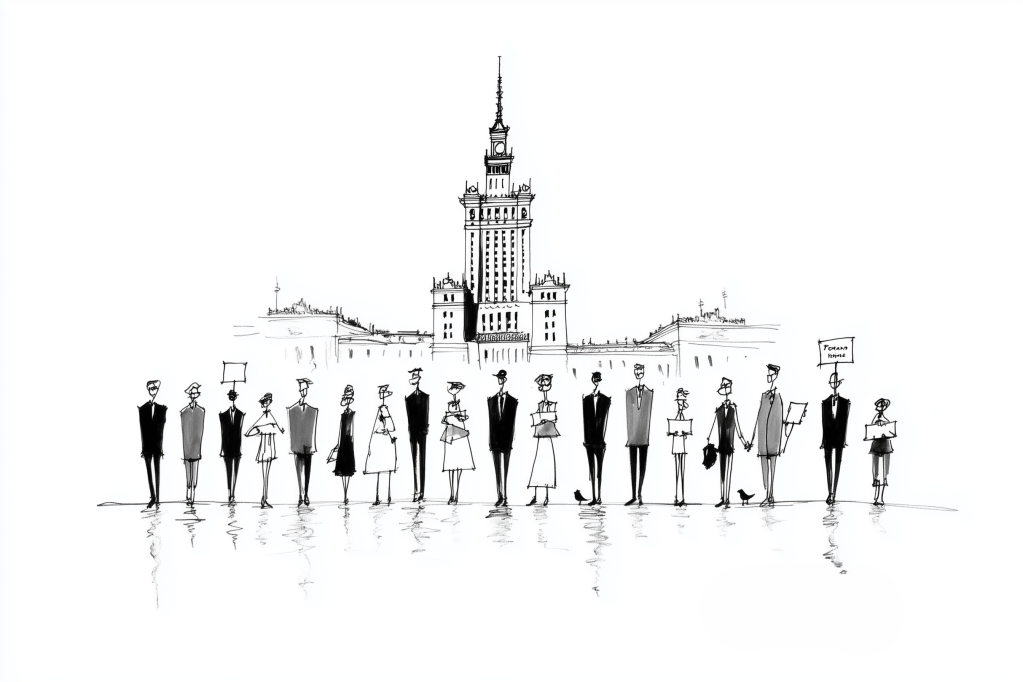
NCN Grant on Pandemic Protests in Poland: Activities in 2025
We, the research team funded by the National Science Centre (NCN), Poland (2021/43/B/HS6/01155) grant entitled “The Construction of Post-Pandemic Society: Covid-19 Street Protest in Poland,” published articles, organized a conference, and presented research in 2025. Articles Published in 2025 Radiukiewicz, Anna, Joshua Dubrow, and Alan Żukowski. “Multimodal approaches to the reconstruction of street protest events…
-

Empirical Research on Protests and Social Movements in Central and Eastern Europe: Conference 2025
Empirical Research on Protests and Social Movements in Central and Eastern Europe: State of the Art Institute of Philosophy and Sociology, Polish Academy of Sciences (IFiS PAN)72 Nowy Swiat, Warsaw, Poland December 4 – 5, 2025 About Major events in Europe over the last two decades — financial crises, rising populism, EU skepticism, pandemic, and…
-
Joseph Stiglitz: Democracy, Justice, and Inequality
Why is inequality bad for democracy and justice? What can be done about it? In this post, we present the works of Joseph Stiglitz, a Nobel laureate, economist, and professor at Columbia University. Focusing on three of his key books, “The Price of Inequality,” “The Great Divide,” and “People, Power, and Profits,” we present Stiglitz’s…
-

Naomi Klein on Disaster Capitalism and Political Change
Why does the news seem overwhelming? How can we get past the “shock” and change the world for the better? In this post, we present the ideas of Naomi Klein, a renowned author and activist whose work has made a significant impact on discussions surrounding social change. Klein’s thoughts and theories help us understand the…
-

President Obama on Money in Politics
The influence of money in politics continues to undermine American democracy. Despite former President Obama’s well-intentioned efforts to tackle this pervasive problem, his administration’s attempts fell short. We explore Obama’s fight against the corrupting power of money in politics, including the various initiatives he championed and the obstacles he faced, such as the Citizens United…
-

Piketty: Policy, Institutions, and a Brief History of Equality
Does equality rise? What is the role of policy, institutions, and collective mobilization for increasing equality? This post delves into the work of French economist Thomas Piketty, whose influential books examine wealth and income inequality. Piketty highlights the long-term trend towards greater political, economic, and social equality, driven by political mobilizations, social struggles, and institutional…
-

Ray Dalio on Power, Money, and Societal Collapse
What is the relationship between money, power, and the collapse of society? This blog post presents the ideas of Ray Dalio, billionaire investor and author of “Principles for Dealing with the Changing World Order: Why Nations Succeed and Fail.” Dalio explores his ideas about a Big Cycle and international relations, highlighting the interplay of how…
-

Effects of Political Inequality on Society
Inequality — economic, political, social — is at the heart of society’s troubles. Political inequality is a particular kind and it has many definitions. In the main, it refers to structured differences in influence and outcomes of political processes. What are the effects of political inequality on society? Here we explore the consequences of political…
-

Power Inequality: Trends in Europe
Inequality is generally understood as long-standing structured differences in social, economic, legal, and political resources. Inequalities intersect, such that power inequality is associated with economic, legal, social, and political inequality. What is power inequality? Power inequality is defined as structured differences in the capacity of principals to realize their will against the interests and efforts…
-

Gender Quotas in Politics
Gender quotas in politics are rules that aim at providing opportunities for women to be in parliament or to appear on candidate lists in elections for political office. In this post, we discuss the types of gender quotas in politics, how parliaments in democracy adopt quotas, whether they are effective in placing more women in…
-
Visions of a Post-Pandemic Society via Street Protest in Poland: NCN Grant (2021/43/B/HS6/01155)
We are looking for hired a post-doctoral scholar and a graduate research assistant to be part of the research team led by dr. hab. Joshua K. Dubrow at IFiS PAN on the implementation of the international research project funded by the National Science Centre, Poland (2021/43/B/HS6/01155) entitled “The Construction of Post-Pandemic Society: Covid-19 Street Protest…
-

Political Equality in V-Dem: “Power distributed by gender”
In a previous post, we discussed how the Varieties of Democracy “V-Dem” project measures “political equality.” V-Dem is an expert survey. They guide the expert-respondents’ attention to particular groups’ political equality. These groups are: (a) socioeconomic position, (b) social groups, (c) gender, and (d) sexual orientation. In this post, we discuss how they measure “Power…
-
Political Equality in V-Dem: “Power distributed by sexual orientation”
In a previous post, we discussed how the Varieties of Democracy “V-Dem” project measures “political equality.” V-Dem is an expert survey. They guide the expert-respondents’ attention to particular groups’ political equality. These groups are: (a) socioeconomic position, (b) social groups, (c) gender, and (d) sexual orientation. In this post, we discuss how they measure “Power…
-

Political Equality in V-Dem: “Power distributed by social group”
In a previous post, we discussed how the Varieties of Democracy “V-Dem” project measures “political equality.” V-Dem is an expert survey. They guide the expert-respondents’ attention to particular groups’ political equality. These groups are: (a) socioeconomic position, (b) social groups, (c) gender, and (d) sexual orientation. In this post, we discuss how they measure “Power…
-

Political Equality as Measured by Varieties of Democracy (V-Dem)
If we want to measure the power structure of society, we can examine the extent of political equality. For a quantitative measure, one can use the Varieties of Democracy (V-Dem, as it is commonly referred to) dataset’s “political equality” measure (see also Cole 2018). In this post, I examine and critique the “political equality” measure…
 Political Inequality: A blog since 2010