Category: Measurement
-

Every protest is an imagined future
Protests often emerge from a mix of grievance and hope – i.e., dissatisfaction with the present with an aim to change it for the better. Whereas street protests are commonly understood as physical, dynamic, interactive, and collective expressions of objection and dissent, less common is the idea that this form of collective action is future-oriented;…
-

Ray Dalio on Power, Money, and Societal Collapse
What is the relationship between money, power, and the collapse of society? This blog post presents the ideas of Ray Dalio, billionaire investor and author of “Principles for Dealing with the Changing World Order: Why Nations Succeed and Fail.” Dalio explores his ideas about a Big Cycle and international relations, highlighting the interplay of how…
-

Power Inequality: Trends in Europe
Inequality is generally understood as long-standing structured differences in social, economic, legal, and political resources. Inequalities intersect, such that power inequality is associated with economic, legal, social, and political inequality. What is power inequality? Power inequality is defined as structured differences in the capacity of principals to realize their will against the interests and efforts…
-

Social Movement Outcomes
Do social movements cause social change? How would we know? We look to the success of the civil rights movement in the United States and conclude, “Yes, social movements matter.” But, there are many social movements around the world, and there are many social changes. How do we know if social movements cause social change?…
-

Youth and Political Participation
What does “Youth” or “Young” mean in political participation studies? Most studies of political participation that feature multivariate regression use age as a linear variable. The few that do present “age groups” (i.e. age ranges) as a series of dichotomous variables can differ quite a bit on how to conceptualize “youth” and “young” For example,…
-

Political Equality in V-Dem: “Power distributed by gender”
In a previous post, we discussed how the Varieties of Democracy “V-Dem” project measures “political equality.” V-Dem is an expert survey. They guide the expert-respondents’ attention to particular groups’ political equality. These groups are: (a) socioeconomic position, (b) social groups, (c) gender, and (d) sexual orientation. In this post, we discuss how they measure “Power…
-

Political Equality in V-Dem: “Power distributed by sexual orientation”
In a previous post, we discussed how the Varieties of Democracy “V-Dem” project measures “political equality.” V-Dem is an expert survey. They guide the expert-respondents’ attention to particular groups’ political equality. These groups are: (a) socioeconomic position, (b) social groups, (c) gender, and (d) sexual orientation. In this post, we discuss how they measure “Power…
-

Political Equality in V-Dem: “Power distributed by social group”
In a previous post, we discussed how the Varieties of Democracy “V-Dem” project measures “political equality.” V-Dem is an expert survey. They guide the expert-respondents’ attention to particular groups’ political equality. These groups are: (a) socioeconomic position, (b) social groups, (c) gender, and (d) sexual orientation. In this post, we discuss how they measure “Power…
-

Political Equality as Measured by Varieties of Democracy (V-Dem)
If we want to measure the power structure of society, we can examine the extent of political equality. For a quantitative measure, one can use the Varieties of Democracy (V-Dem, as it is commonly referred to) dataset’s “political equality” measure (see also Cole 2018). In this post, I examine and critique the “political equality” measure…
-
Political Voice and Economic Inequality: Institutional Factors
We at the POLINQ project examined 18 quantitative cross-national articles by major scholars in the leading journals to develop a typology of institutional factors that influence the relationship between political voice and economic inequality. We comment on how scholars have measured these factors, or “concepts.” At a glance… Institutional Factors that Link Voice to Inequality…
-

Democratic Backsliding: Definition and Measurement
What is democratic backsliding? Democratic backsliding is when a democratic country shows signs of becoming autocratic or authoritarian. Backsliding can occur when a democracy has just a foothold (e.g. Poland in the early 1990s) or is firmly established as a democracy (the USA). How do we know when democratic backsliding occurs? Social scientists typically use…
-

POLINQ: Political Inequality and Political Voice across Nations and Time
What is POLINQ Political Inequality? POLINQ is an acronym for political inequality, defined as structured differences in political influence and its consequences. POLINQ is also the acronym of the National Science Foundation, Poland funded project (2016/23/B/HS6/03916), which ran from 2017 – 2022, with Joshua K. Dubrow as the Principle Investigator. POLINQ was housed at the…
-

How Political Voice Fares in an Age of Rising Inequality: Frederick Solt’s Research on Economic Inequality and Democracy
Political Voice and Economic Inequality The basics of modern life — job, education, and income — can shape our interest in politics, our desire to discuss politics with others, and our decision to vote. In the parlance of social science, occupation and socioeconomic status may impact “political engagement,” otherwise known as political voice. We politically…
-
Interview with Gwangeun Choi on Economic and Political Inequality in Cross-national Perspective
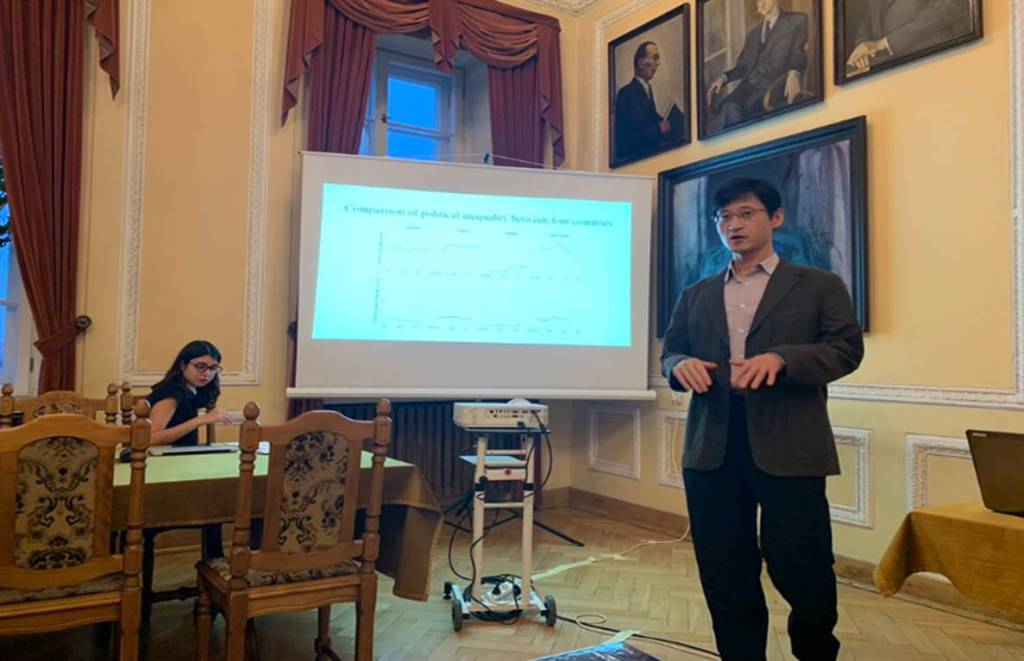
Gwangeun Choi presented the paper, “The Link between Economic and Political Inequality in Cross-National Perspective” at the Politics and Inequality conference held in Warsaw, Poland in December 2018. Dr. Choi recently received a PhD in Government at the University of Essex in the UK. His research interests are in the areas of democracy, quality of…
-

Five Problems with Measuring Political Inequality
Five reasons why measuring political inequality is difficult.
 Political Inequality: A blog since 2010