Category: Representation
-

Power Inequality: Trends in Europe
Inequality is generally understood as long-standing structured differences in social, economic, legal, and political resources. Inequalities intersect, such that power inequality is associated with economic, legal, social, and political inequality. What is power inequality? Power inequality is defined as structured differences in the capacity of principals to realize their will against the interests and efforts…
-

Political Equality in V-Dem: “Power distributed by gender”
In a previous post, we discussed how the Varieties of Democracy “V-Dem” project measures “political equality.” V-Dem is an expert survey. They guide the expert-respondents’ attention to particular groups’ political equality. These groups are: (a) socioeconomic position, (b) social groups, (c) gender, and (d) sexual orientation. In this post, we discuss how they measure “Power…
-
Political Equality in V-Dem: “Power distributed by sexual orientation”
In a previous post, we discussed how the Varieties of Democracy “V-Dem” project measures “political equality.” V-Dem is an expert survey. They guide the expert-respondents’ attention to particular groups’ political equality. These groups are: (a) socioeconomic position, (b) social groups, (c) gender, and (d) sexual orientation. In this post, we discuss how they measure “Power…
-
Democracy and Economic Inequality
Why does economic inequality rise in democracies? Economic inequality is rising, and the United Nations reports that economic inequality impacts 70 percent of the world, even when we include democracies such as the US, UK, France, and Germany. Why does democracy not reduce economic inequality? According to democratic theories, giving everyone the vote and allowing…
-

Notes on Manza’s Essay “Political Inequality”
Social Scientist Jeff Manza Explored Political Inequality Social scientist Jeff Manza wrote an article for Emerging Trends in the Social and Behavioral Sciences on “Political Inequality” (2015). This post, in politicalinequality.org, provides notes and critique of Jeff Manza’s article. Manza: Economic Inequality is Political Inequality The abstract of the essay makes the ubiquitous argument that…
-

The Meaning of Political Voice
What does political voice mean? Political voice is commonly understood as an important part of democracy. Academics and the public use the term political voice. While academics use the term often, it is more important to know how the public uses and understands the term. After all, there is more of the public than there…
-

Gender and Political Inequality in Eastern Europe: Open Access Resources from the POLINQ Project
What is the relationship between gender and political inequality (POLINQ)? Despite the promises of political equality of the Communist era, and the promises of the post-Communist era, from 1945 to now women in Eastern Europe have endured political inequality. Political inequality is defined as structured differences in influence over political decisions, and the outcomes of…
-

POLINQ: Political Inequality and Political Voice across Nations and Time
What is POLINQ Political Inequality? POLINQ is an acronym for political inequality, defined as structured differences in political influence and its consequences. POLINQ is also the acronym of the National Science Foundation, Poland funded project (2016/23/B/HS6/03916), which ran from 2017 – 2022, with Joshua K. Dubrow as the Principle Investigator. POLINQ was housed at the…
-
Party Issue Positions and Legislative Actions on Corruption in Ukraine, 2002 – 2017
by Nika Palaguta, Graduate School for Social Research, Polish Academy of Sciences This research was funded by the Preludium grant of the National Science Centre, Poland [Narodowe Centrum Nauki]. Project number: 2017/25/N/HS6/01174. Project Name: Influence of party ideology and characteristics of parliamentarians on legislative actions on war, corruption and inequality in Ukraine [Wpływ ideologii partii…
-

Political Inequality of Women in Ukraine: Conservatism and Enduring Stereotypes
by Nika Palaguta, Graduate School for Social Research, Polish Academy of Sciences This research was funded by the Preludium grant of the National Science Centre, Poland [Narodowe Centrum Nauki]. Project number: 2017/25/N/HS6/01174. Project Name: Influence of party ideology and characteristics of parliamentarians on legislative actions on war, corruption and inequality in Ukraine [Wpływ ideologii partii…
-
Workshop: Women’s Political Inequality in Poland and Ukraine
We announce the workshop, “Women’s Political Inequality in Poland and Ukraine: Theory Statements and Empirical Research,” on April 23, 2019 at the Institute of Philosophy and Sociology, Polish Academy of Sciences (IFiS PAN), Warsaw, Poland (Pałac Staszica, Nowy Świat 72, Warsaw, Room 154). This one-day workshop brings together scholars of Poland and Ukraine on women’s…
-
Interview with Constantin Manuel Bosancianu on Party–Voter Ideological Congruence and Socioeconomic Biases in Representation
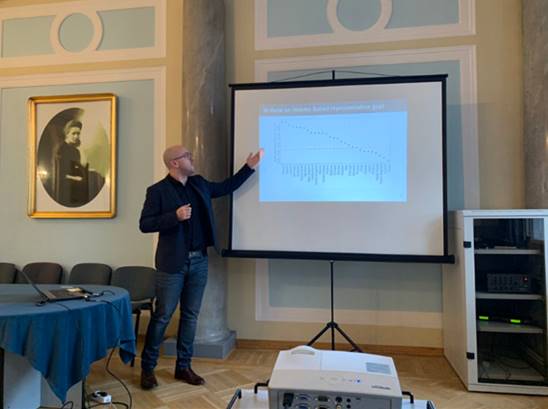
Constantin Manuel Bosancianu, of WZB Berlin Social Science Center, Germany, presented the paper, “Party–Voter Ideological Congruence and Socio-Economic Biases in Representation: OECD over the Past 5 Decades” at the Politics and Inequality conference held in Warsaw, Poland in December 2018. Constantin Manuel Bosancianu is a postdoctoral researcher in the “Institutions and Political Inequality” unit at…
-
When Local Governments Protested the USA Patriot Act
Mass Protests over Federal Government Policy The US Presidential of 2016 election sparked protests across the nation. There were mass demonstrations over immigration and refugee policies, pro-Trump rallies, town hall debates over health care, the Women’s March on Washington, and declarations of support for sanctuary cities, to name just a few. We have not seen such…
-

What Is Political Inequality and How Unequal Are We?
We Know a lot about Economic Inequality When the Occupy Wall Street movement reached its heyday in the Autumn of 2011, spreading to cities all over the world, the protesters’ rallying cry was, “We are the 99 percent.” They hoped for political change, among other things, but “99” was mainly understood as a statement about…
 Political Inequality: A blog since 2010