Tag: political voice
-

Notes on Manza’s Essay “Political Inequality”
Social Scientist Jeff Manza Explored Political Inequality Social scientist Jeff Manza wrote an article for Emerging Trends in the Social and Behavioral Sciences on “Political Inequality” (2015). This post, in politicalinequality.org, provides notes and critique of Jeff Manza’s article. Manza: Economic Inequality is Political Inequality The abstract of the essay makes the ubiquitous argument that…
-

The Meaning of Political Voice
What does political voice mean? Political voice is commonly understood as an important part of democracy. Academics and the public use the term political voice. While academics use the term often, it is more important to know how the public uses and understands the term. After all, there is more of the public than there…
-

POLINQ: Political Inequality and Political Voice across Nations and Time
What is POLINQ Political Inequality? POLINQ is an acronym for political inequality, defined as structured differences in political influence and its consequences. POLINQ is also the acronym of the National Science Foundation, Poland funded project (2016/23/B/HS6/03916), which ran from 2017 – 2022, with Joshua K. Dubrow as the Principle Investigator. POLINQ was housed at the…
-
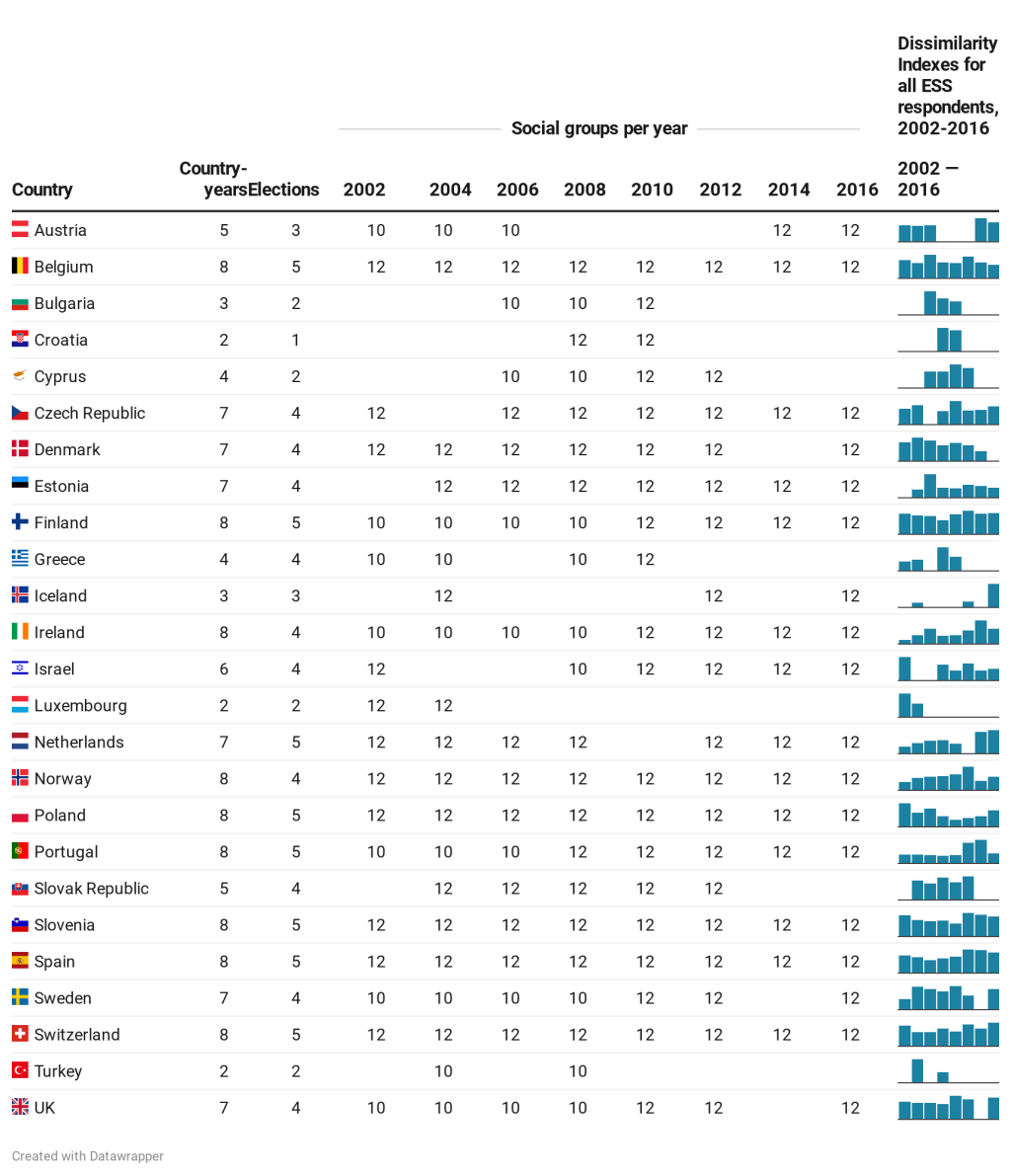
Introducing PaReSoGo, Dataset on Party Representation of Social Groups
PaReSoGo at a Glance Why PaReSoGo – Party Representation of Social Groups? Parties and parliamentarians are charged with the responsibility to express and translate the voice of the masses in the legislature. A classic concern is the extent to which political parties who attained seats in parliament represent the masses; a smaller current in the…
-

How Political Voice Fares in an Age of Rising Inequality: Frederick Solt’s Research on Economic Inequality and Democracy
Political Voice and Economic Inequality The basics of modern life — job, education, and income — can shape our interest in politics, our desire to discuss politics with others, and our decision to vote. In the parlance of social science, occupation and socioeconomic status may impact “political engagement,” otherwise known as political voice. We politically…
-

Interview with Catherine Bolzendahl on Women’s Political Empowerment Worldwide
Catherine Bolzendahl, Associate Professor in the Department of Sociology of the University of California-Irvine, recently delivered the keynote speech, “Women’s Political Empowerment: A Path toward Progress in Uncertain Times,” at the Politics and Inequality conference held December 2018 in Warsaw, Poland. Catherine Bolzendahl’s interests are in political change cross-nationally and over time, as well as…
-
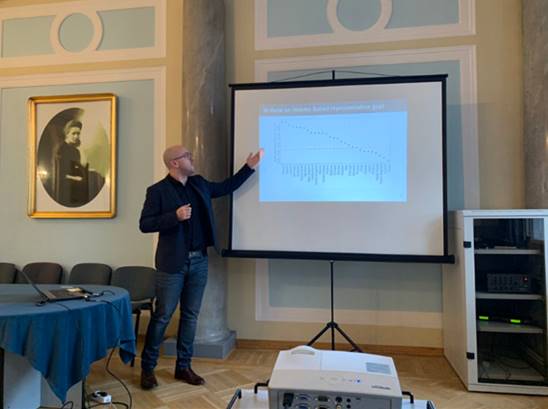
Interview with Constantin Manuel Bosancianu on Party–Voter Ideological Congruence and Socioeconomic Biases in Representation
Constantin Manuel Bosancianu, of WZB Berlin Social Science Center, Germany, presented the paper, “Party–Voter Ideological Congruence and Socio-Economic Biases in Representation: OECD over the Past 5 Decades” at the Politics and Inequality conference held in Warsaw, Poland in December 2018. Constantin Manuel Bosancianu is a postdoctoral researcher in the “Institutions and Political Inequality” unit at…
-

How Do Digital Technologies Impact Political Inequality?
This post discusses the relationship between digital technologies — the internet and its hardware — and political inequality. This is part of the POLINQ project. In this project, we have understood that political inequality has many definitions. Thesis: Digital technologies have enabled a dystopic political inequality where politics is possible for the few and impossible…
-

Neoliberalism and Democracy
Neoliberalism has degraded democracy through its ideological control over the economy, polity, and the cultural sphere.
-

Elites care about inequality, but probably not in the way that you think
This is a guest post by Matias Lopez, Universidad Católica, Chile. Do the elite care about inequality? A survey of over 800 elites in six Latin American countries reveals that they acknowledge economic inequality as a problem, but see little incentive to reduce inequality. The elite from stronger and more stable democracies tend to be…
-

Five Problems with Measuring Political Inequality
Five reasons why measuring political inequality is difficult.
-

What Is Political Inequality and How Unequal Are We?
We Know a lot about Economic Inequality When the Occupy Wall Street movement reached its heyday in the Autumn of 2011, spreading to cities all over the world, the protesters’ rallying cry was, “We are the 99 percent.” They hoped for political change, among other things, but “99” was mainly understood as a statement about…
-

Notes on Winters and Page’s “Oligarchy in the U.S.?”
In this post, I summarize the article “Oligarchy in the U.S.,” by Winters and Page (2009). Winters and Page: Oligarchy in the USA Winters and Page (Hereafter, WP) argue that all modern democracies, regardless of level of democracy, can be oligarchies. Oligarchy and democracy can, and do, “coexist comfortably” (731). WP ask whether the U.S.…
-
Defining and Measuring Political Resources
What is the definition of political resources? The definition and measurement of political inequality requires a definition of political resources. Let’s start with a definition of political inequality. Political inequality is structured differences in political influence over government decisions, and the outcomes of those decisions. There are two main points about political resources: Are political resources…
 Political Inequality: A blog since 2010